
Guide
How High of a Ceiling Do You Need for a Golf Simulator?
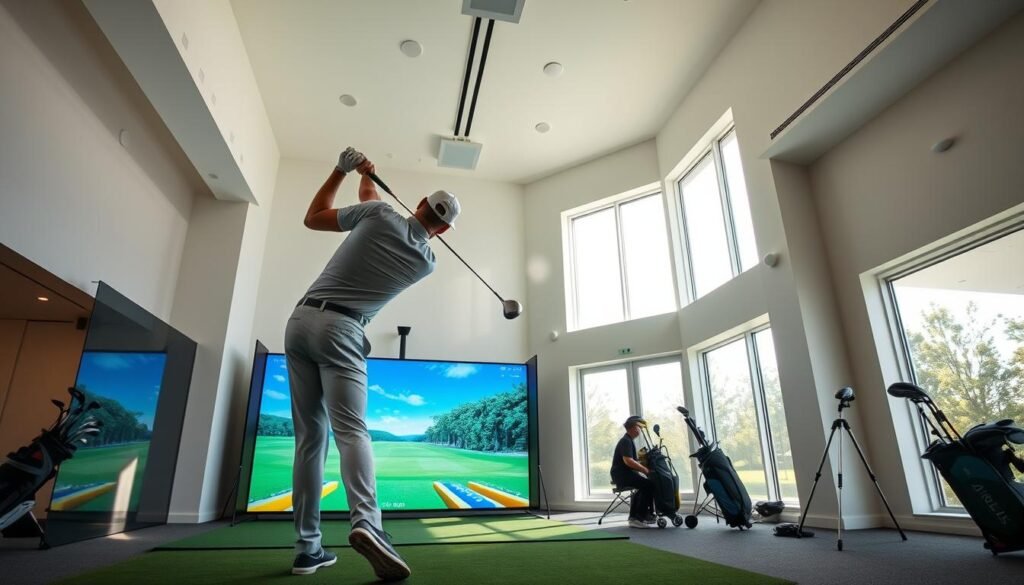
For most golfers, a ceiling of 10 feet lets you swing every club, including the driver, without worrying about the ceiling. 9 feet works for many golfers under about 6 feet tall. 8.5 feet can work for shorter players or for irons and wedges, and 8 feet is tight: many golfers cannot swing a driver freely under it.
Your own height, your swing and the club you use matter more than any single number. This guide covers how much height you need, how to test your own swing, what to do if your ceiling is 8 or 9 feet, and what else uses up headroom in a garage, basement or shed.
Key Takeaways
- 10 feet is comfortable for nearly everyone; 9 feet suits most golfers under 6 feet.
- 8–8.5 feet can work for shorter golfers, irons and wedges, or a flatter swing, but test before you buy.
- The driver needs the most headroom, at the top of the backswing and in the follow-through.
- Measure your own swing and add a safety margin of about 6 inches.
- Lights, beams, garage door tracks, projectors and overhead launch monitors all reduce usable height.
Ceiling Height by Golfer Height
Use this as a starting point, then test your own swing (see below). Upright swings need more height than flat ones, and the tallest person who will use the simulator sets the requirement.
| Golfer height | Tight but often workable | Comfortable with a driver |
|---|---|---|
| Under 5’8″ | 8.5 ft | 9 ft |
| 5’8″–6’0″ | 9 ft | 9.5–10 ft |
| 6’0″–6’4″ | 9.5 ft | 10–10.5 ft |
| Over 6’4″ | 10 ft | 10.5–11 ft |
Remember that a hitting mat and stance mat raise you by an inch or two, which comes straight off your clearance.

Why Ceiling Height Matters
The club travels highest at the top of the backswing and again in the follow-through. If the ceiling is close, you will either hit it, which can damage the club, the ceiling or a light fitting, or you will shorten your swing without noticing. A swing that changes to fit the room is not the swing you take to the course, so practice is less useful.
Headroom also matters for the ball. A thinned or skied shot can strike the ceiling before it reaches the screen, so many people pad the ceiling between the hitting area and the screen.
How to Measure the Height You Need
- Stand on the mat you will use (or something of the same thickness).
- Use your driver, and make slow practice swings first. Have someone watch from the side, or film your swing on your phone.
- Mark or measure the highest point the clubhead reaches in the backswing and the follow-through.
- Add about 6 inches as a safety margin for faster swings and small changes in posture.
- Repeat for the tallest person who will use the simulator.
If your measurement plus margin is below your ceiling, a full swing should be fine. If not, read the section on lower ceilings below.
Can You Have a Golf Simulator With an 8-Foot Ceiling?
Sometimes. An 8-foot ceiling is common in basements and garages, and some golfers make it work, especially if they are shorter or have a flatter swing. It usually means accepting limits:
- Irons and wedges only, or driver with a shorter, controlled swing.
- Choke down on longer clubs to shorten the arc.
- Use the highest spot in the room. Place the hitting area between joists or away from beams, ducts and light fittings.
- Pick a launch monitor that sits on the floor (beside or behind the ball) rather than one mounted on the ceiling.
- Use a thin mat so you are not standing higher than you need to.
If several people will use the simulator, or a tall golfer wants to swing a driver freely, 8 feet is likely to be too low.
Is a 9-Foot Ceiling High Enough?
For most golfers under about 6 feet, yes. You should be able to swing irons and usually the driver with a normal swing. Taller golfers and those with upright swings should test their driver first: a 9-foot ceiling may be fine for irons but tight for the longest clubs.
What Is Too Low for a Golf Simulator Ceiling?
Your ceiling is too low if:
- your club touches the ceiling, or comes within a few inches of it, during a normal practice swing;
- you find yourself shortening your backswing or follow-through to avoid it;
- the only way to fit is to swing irons at half speed.
As a general guide, below about 8 feet a full swing is not practical for most adults.
Garages, Basements, Sheds and Roof Height
Garages
Garages often have enough width and depth, but the garage door, its tracks and the opener can hang well below the ceiling. Measure from the floor to the lowest of these, not to the ceiling itself. Many people set the hitting area towards the back of the garage, away from the door mechanism.
Basements
Beams, ducts, pipes and drop-ceiling grids reduce headroom. Measure under the lowest one in your swing area. Removing a drop-ceiling tile or rerouting a duct can sometimes gain the inches you need.
Sheds, outbuildings and pitched roofs
For a shed or outbuilding, what matters is the clear height inside, not the roof’s outside height. With a pitched or vaulted roof, put the hitting area under the highest point. Allow for roof beams and insulation, and check local rules before building; see whether you need planning permission for a golf simulator.

Projectors and Overhead Launch Monitors
Overhead equipment uses up headroom too:
- Projectors need to be mounted out of your swing path and positioned so you don’t cast a shadow on the screen. Short-throw projectors can be mounted further forward, closer to the screen.
- Ceiling-mounted launch monitors (for example some Uneekor and Foresight models) need to be fitted at a specific height above the ball. Check the maker’s mounting requirements before buying; if your ceiling is low, a floor-standing launch monitor may suit better.
Width and Depth Matter Too
Ceiling height is only one of three measurements. As a rough guide, allow about 12–15 feet of width (more if left- and right-handed golfers will share it) and about 15–20 feet of depth from the screen to the back of the room. Radar launch monitors usually need the most depth. For full details see:
- How much space you need for a home golf simulator
- The minimum room size for a golf simulator
- Whether a 12×12 room is big enough
Once you know your space, see how much a home golf simulator costs. If you would rather have a professional assess the room, you can find a golf simulator installer near you.
FAQ
What is the minimum ceiling height for a golf simulator?
About 8.5 feet for shorter golfers, and 9 feet for most adults. Ten feet is comfortable for nearly everyone, including tall golfers using a driver.
Can you use a golf simulator with an 8-foot ceiling?
Sometimes, mainly for shorter golfers, irons and wedges, or a shorter driver swing. Test your swing first, use a thin mat and a floor-standing launch monitor, and set up in the highest part of the room.
Is a 9-foot ceiling enough for a golf simulator?
For most golfers under about 6 feet, yes. Taller golfers or those with upright swings should test a full driver swing before buying.
How high does a roof need to be for a golf simulator in a shed or garage?
What counts is the clear inside height under the lowest beam, door track or fitting. Aim for 9–10 feet of clear height, with the hitting area under the highest point of a pitched roof.
How do I check whether my ceiling is high enough?
Stand on your mat, make slow practice swings with your driver while someone watches or films, measure the highest point the club reaches, and add about 6 inches. If that is below your ceiling, you have enough room.
Does the projector affect the ceiling height I need?
It can. A ceiling-mounted projector must sit outside your swing path, and ceiling-mounted launch monitors need a set mounting height. In low rooms, short-throw projectors and floor-standing launch monitors are easier to fit.